
🔹 Core Principle
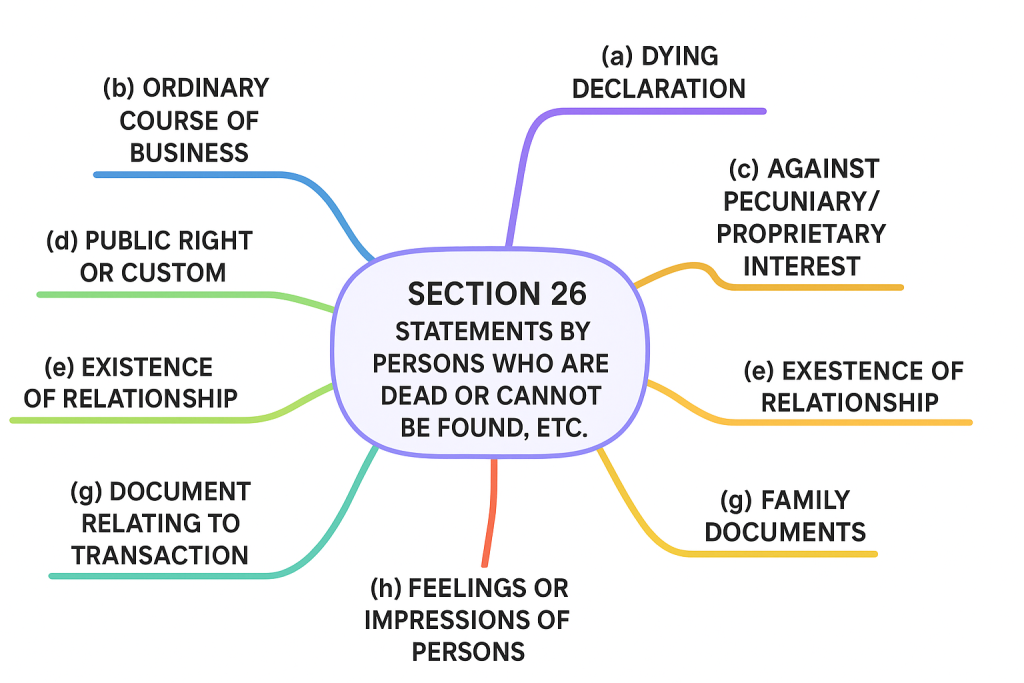
When a person whose statement would be relevant is dead, cannot be found, has become incapable of giving evidence, or whose attendance cannot be procured without unreasonable delay or expense, their statement (written or verbal) can itself become a relevant fact.
These are exceptions to the rule against hearsay.
⚖️ Eight Categories of Admissible Statements
| Clause | Type of Statement | Explanation |
|---|---|---|
| (a) | Dying Declaration | Statement as to cause of death or circumstances of the transaction resulting in death — relevant in cases where the cause of that person’s death is in question. 👉 Expectation of death not necessary. 👉 Applies in both criminal and civil cases. |
| (b) | Statement Made in Ordinary Course of Business | Entries, memos, acknowledgments, receipts, documents used in commerce, or dated letters written/signed in ordinary course of business. |
| (c) | Statement Against Interest | Statement against pecuniary, proprietary, or criminal interest of the person making it — relevant because such statements are presumed to be true. |
| (d) | Statement on Public Right or Custom | Opinion of a deceased or missing person regarding existence of public right, custom, or matter of public/general interest, made before any controversy arose. |
| (e) | Statement Relating to Relationship | Statements relating to relationship by blood, marriage, or adoption, made before dispute arose, by a person having special knowledge. |
| (f) | Statement in Family Documents or Monuments | Statements of relationship made in wills, deeds, family pedigrees, tombstones, family portraits, etc., before the dispute arose. |
| (g) | Statement in Deed, Will, or Document Relating to Transaction (Section 11 type) | Statements in documents relating to transactions mentioned in Section 11 (i.e., those creating or affecting rights or customs). |
| (h) | Statements Showing Feelings or Impressions | Statements made by a number of persons expressing relevant feelings or impressions (e.g., remarks of a crowd) are admissible. |
📘 Illustrations Explained
| Illustration | Scenario | Relevance Clause |
|---|---|---|
| (a) | A’s statement about being murdered/raped/killed in a transaction leading to death | (a) – Dying declaration |
| (b) | Deceased surgeon’s diary entry about delivering A’s mother | (b) – Ordinary course of business |
| (c) | Deceased solicitor’s diary about meeting A in Nagpur | (b) – Ordinary course of business |
| (d) | Letter from deceased merchant stating ship sailed | (b) – Ordinary course of business |
| (e) | Agent’s letter to A about rent received | (b) – Ordinary course of business |
| (f) | Deceased clergyman’s statement that he married A & B | (e) – Relationship |
| (g) | Letter dated by missing person | (b)/(g) – Business/document evidence |
| (h) | Captain’s protest about shipwreck | (b) – Ordinary business document |
| (i) | Deceased village headman’s statement that road is public | (d) – Public right/custom |
| (j) | Statement of price by deceased businessman | (b) – Ordinary business |
| (k) | Statement by A that B is his son | (e) – Relationship |
| (l) | Father’s letter announcing birth of A | (e) – Relationship |
| (m) | Entry by father about daughter’s marriage | (f) – Family record |
| (n) | Remarks of spectators on caricature’s similarity | (h) – Feelings/impressions |
⚖️ Judicial Notes / Case Law Reference
| Case | Principle |
|---|---|
| Pakala Narayana Swami v. Emperor (1939) | Dying declaration includes statements explaining circumstances of transaction leading to death. |
| Sharad Birdhichand Sarda v. State of Maharashtra (1984) | Dying declaration must inspire full confidence; can form sole basis of conviction. |
| Tehal Singh v. State of Punjab (1979) | Business records of deceased person admissible under ordinary course of business clause. |
| R v. Mead (1823) | Statements against interest presumed to be true due to absence of motive to lie. |
📚 Key Takeaways for Judicial Exam
- Section 26 = Hearsay exceptions (dead, missing, incapable, or unavailable witness).
- Dying declaration doesn’t require expectation of death.
- Covers 8 categories (a)–(h) — memorize with mnemonic:
👉 “Death–Business–Interest–Public–Relation–Family–Document–Impression” - Statement must be made before controversy arose (clauses d–f).
- Purpose – to admit evidence that would otherwise be lost.
- Used in both civil and criminal cases, depending on context.
10 advanced, exam-level MCQs (with explanations) based on Section 26, Bharatiya Sakshya Adhiniyam, 2023 — essential for Judicial Services Prelims:
🧠 SECTION 26 – MCQs
Q1. A, during an assault, told B that “C stabbed me.” A died shortly after. In a case where C is charged with A’s murder, this statement is—
(a) Irrelevant as A was not expecting death
(b) Relevant as a dying declaration
(c) Hearsay and inadmissible
(d) Relevant only if A was under oath
✅ Answer: (b)
Explanation: Under Section 26(a), statements as to cause of death are relevant whether or not made under expectation of death. Expectation of death is not necessary.
Q2. A deceased accountant’s diary contained an entry showing daily transactions of the firm. The diary is produced to prove receipt of payment. The entry is—
(a) Irrelevant unless signed by the employer
(b) Relevant as made in ordinary course of business
(c) Hearsay evidence
(d) Secondary evidence only
✅ Answer: (b)
Explanation: Section 26(b) — entries made in books kept in ordinary course of business are relevant facts.
Q3. A’s written statement before death that “this land belongs to B, not me” is sought to be proved. The statement is—
(a) Irrelevant because A is dead
(b) Relevant because it is against A’s proprietary interest
(c) Relevant only if made under oath
(d) Admissible only if made in presence of B
✅ Answer: (b)
Explanation: Section 26(c) — statements against proprietary or pecuniary interest are admissible as relevant facts.
Q4. A village headman, now deceased, had written that “this road has always been used by public.” The statement is tendered in evidence to prove public right of way. It is—
(a) Inadmissible hearsay
(b) Relevant as statement on public right
(c) Irrelevant since controversy arose later
(d) Admissible only if signed by Gram Sabha
✅ Answer: (b)
Explanation: Section 26(d) — statements on existence of public right or custom made before any controversy arose are relevant.
Q5. The statement by A, now dead, that “B is my adopted son” is tendered to prove relationship. It was made years before any dispute. It is—
(a) Inadmissible for want of documentary proof
(b) Relevant as A had special means of knowledge
(c) Hearsay and not admissible
(d) Relevant only if made in will
✅ Answer: (b)
Explanation: Section 26(e) — statement as to relationship by blood, marriage or adoption made before dispute by a person with special knowledge is relevant.
Q6. A deceased person’s will mentions that “my daughter C was married to D in 2015.” The statement is offered to prove C’s marriage. It is—
(a) Irrelevant because it is in a private document
(b) Relevant as family record statement
(c) Relevant only if registered
(d) Hearsay unless proved by witness
✅ Answer: (b)
Explanation: Section 26(f) — statements about relationship in family documents, wills, deeds, pedigrees, tombstones, etc. are relevant if made before dispute arose.
Q7. A letter written by a deceased merchant states: “The goods were shipped from Mumbai on 1st June.” In a suit about shipment date, this is—
(a) Inadmissible because it’s not notarized
(b) Relevant as part of business communication
(c) Irrelevant since author is deceased
(d) Secondary evidence only
✅ Answer: (b)
Explanation: Section 26(b) — letters or documents written in ordinary course of business are relevant.
Q8. Statements in an old deed relating to creation of a trust for village common land are relied upon to prove existence of such right. These statements are—
(a) Irrelevant since author is dead
(b) Relevant under clause (g) of Section 26
(c) Admissible only if deed is registered
(d) Hearsay evidence
✅ Answer: (b)
Explanation: Section 26(g) — statements in documents relating to transactions (e.g., deeds, wills) affecting rights or customs are relevant.
Q9. A large crowd witnessed a caricature of B displayed publicly. Remarks by spectators showing that it was insulting are offered in evidence. These remarks are—
(a) Irrelevant as opinions of third parties
(b) Relevant as they express feelings or impressions
(c) Hearsay and inadmissible
(d) Admissible only if recorded contemporaneously
✅ Answer: (b)
Explanation: Section 26(h) — statements of feelings or impressions of several persons relevant to matter in question are admissible.
Q10. Which of the following statements about Section 26 is incorrect?
(a) It is an exception to hearsay rule
(b) It applies only in criminal proceedings
(c) It includes statements made in ordinary course of business
(d) It includes statements against proprietary interest
✅ Answer: (b)
Explanation: Section 26 applies to both civil and criminal proceedings, whenever cause of death or related facts come into question.
