
— A Comprehensive Summary for Legal Practitioners & Students
The Hon’ble Supreme Court of India, in its recent judgment dated 25 September 2025, has issued a fresh and powerful set of guidelines to speed up cheque bounce litigation under Section 138 of the Negotiable Instruments Act, 1881.
These directions aim to tackle the massive pending backlog, streamline service of summons, promote early settlement, standardize procedure, and enhance digital compliance.
This judgment restores the conviction of the accused and sets out policy-level reforms binding on all courts across India.
⭐ Why Were New Guidelines Needed?
The Supreme Court noted alarming pendency levels in major cities:
- Delhi: 6.50 lakh+ pending S.138 cases
- Mumbai: 1.17 lakh+
- Calcutta: 2.65 lakh+
In some states, Section 138 cases constitute nearly 50% of all trial court pendency.
The Court stressed that cheque bounce offences are quasi-criminal, aimed at securing payment—not punishing the drawer.
📝 Key Observations Before Issuing Guidelines
✔ Presumptions under Sections 118 & 139 NI Act
Once signature on cheque is admitted, courts must presume the cheque was issued in discharge of a legally enforceable debt.
This presumption is rebuttable, but the initial burden is on the accused.
✔ Cash loans above ₹20,000 are not “illegal”
The Supreme Court overruled contrary judgments and clarified that violation of Section 269SS of Income Tax Act does not make the debt unenforceable for NI Act purposes.
✔ Courts cannot re-appreciate facts in revision
High Courts cannot interfere with concurrent findings unless there is perversity.
✔ Failure to reply to demand notice
If the accused does not reply, it becomes an adverse inference in favour of the complainant.
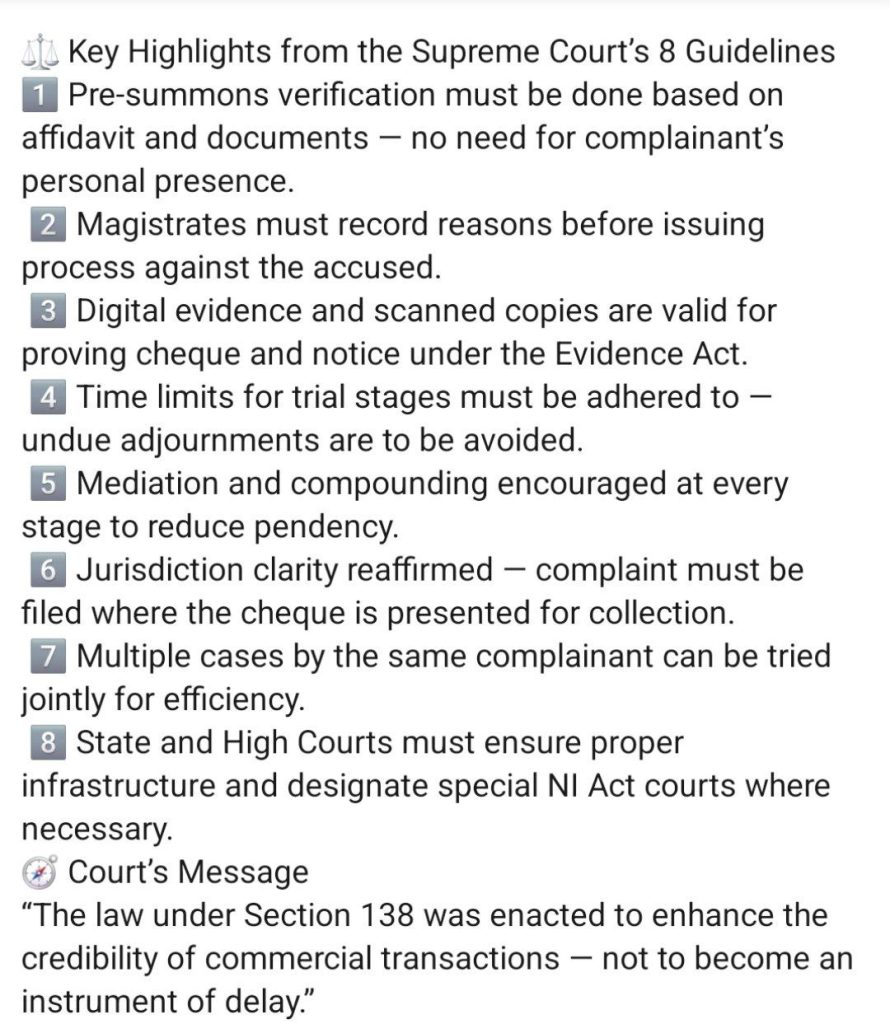
THE SUPREME COURT’S 12 FRESH GUIDELINES (2025)
Effective from 1 November 2025
Below is a crisp, blog-ready summary of each direction:
1. Dasti Summons + Digital Service Mandated
Summons must be served not only through court process, but also via:
- Dasti service by complainant
- WhatsApp / messaging apps
- Mobile number
Complainant must file an affidavit verifying accused’s contact details.
2. Mandatory Affidavit of Service
Complainant must file an affidavit explaining how service was effected.
If affidavit is false → court may take action.
3. Online Payment System for Early Settlement
Every District Court must set up:
- Dedicated online payment link
- UPI / QR code for accused
- Option to pay cheque amount at first hearing
On payment → case may be compounded and closed under Section 147 NI Act.
4. Standard Synopsis Mandated in Every Complaint
A uniform synopsis must be filed at the top of every complaint containing:
- Party details
- Cheque details
- Dishonour memo
- Statutory notice particulars
- Cause of action
- Relief sought
- Interim compensation request
- Pending litigation between same parties
This ensures swift scrutiny at filing stage.
5. No Pre-Cognizance Summons under Section 223 BNSS
The Court approved the Karnataka High Court view:
- Magistrate need not issue summons before taking cognizance.
- Saves crucial time at the initial stage.
6. Summary Trial Is the Rule — Conversion Only With Reasons
Trial Courts must follow summary trial procedure under Section 143 NI Act.
Conversion to summons trial is allowed only with recorded reasons.
To assist this, Court authorized initial questioning of accused under Section 251 CrPC / 274 BNSS:
Sample questions include:
- Do you admit cheque & signature?
- Was liability due?
- Defence—security cheque, repayment, misuse, etc.
- Do you wish to compound?
7. Mandatory Recording of Accused’s Responses
Court must record all answers in the order sheet, helping decide whether summary trial is appropriate.
8. Early Use of Interim Compensation (Section 143A)
Courts must use power for interim compensation at the earliest stage.
9. Physical Hearings After Service of Summons
Once summons is served:
- Matter should be placed before physical courts for better interaction and quicker settlement.
- Online hearings allowed only before service.
10. Evening Courts Must Have Realistic Pecuniary Jurisdiction
High Courts must revise outdated limits.
Example: Delhi’s current ₹25,000 limit is too low.
11. Digital Dashboard for Monitoring (Delhi, Mumbai, Calcutta)
District Courts must maintain dashboards showing:
- Pending cases
- Disposal rates
- Adjournment count
- Settlement rate
- Stage-wise pendency
Quarterly reports to High Courts.
12. High Courts Must Form Special Monitoring Committees
Chief Justices of:
- Delhi
- Bombay
- Calcutta
must set up committees to:
- Review pendency monthly
- Promote mediation, Lok Adalats
- Post experienced magistrates
- Ensure meaningful implementation
Modified Compounding Guidelines (2025 Update)
The Supreme Court revised the old Damodar S. Prabhu (2010) scheme:
(a) Before recording defence evidence → No cost
If accused pays cheque amount before defence evidence → compounding without cost.
(b) After defence evidence but before judgment → 5% cost
(c) In Sessions Court / High Court → 7.5% cost
(d) In Supreme Court → 10% cost
⚖️ Conclusion
The Supreme Court has taken a progressive step to:
- Reduce pendency
- Encourage early settlement
- Increase digital efficiency
- Restore faith in cheque transactions
- Ensure faster justice for complainants
These guidelines will fundamentally transform how India handles cheque bounce litigation, making the process faster, cleaner, and more victim-centric.
